How AI Is Changing Human Discipline (And Why Most People Don’t Notice It Yet)
Artificial intelligence is making humans more productive than ever before.
Tasks that once took hours now take minutes. Writing, coding, brainstorming, researching, planning, editing, designing, and organizing can now happen at near-instant speed with tools like ChatGPT, Claude, Gemini, and AI copilots integrated into everyday work.
On the surface, this looks like a massive upgrade for humanity.
But underneath the productivity boost, a quieter shift is happening — one that most people still do not fully understand.
AI is changing human discipline itself.
And the effects are already everywhere.
The Great Trade-Off Nobody Talks About
Every major technological leap changes human behavior.
The calculator changed mental math.
GPS changed navigation skills.
Social media changed attention spans.
Streaming changed patience.
AI is now changing something even deeper:
The relationship between effort and reward.
For thousands of years, skill development required friction:
Repetition
Practice
Failure
Memory
Patience
Cognitive strain
Now AI can remove large portions of that friction instantly.
Need ideas? AI generates them.
Need summaries? AI condenses them.
Need motivation? AI coaches you.
Need writing? AI drafts it.
Need structure? AI organizes it.
The problem is not that AI helps.
The problem is that humans slowly stop exercising the mental muscles that created the skill in the first place.
Convenience Always Rewires Behavior
Humans adapt faster to convenience than almost anything else.
This is not laziness. It is biology.
Your brain constantly tries to conserve energy. If a shortcut exists, the brain naturally prefers it.
That is why:
People stop memorizing phone numbers
Attention spans shrink with short-form content
Reading depth decreases with infinite scrolling
Critical thinking weakens when answers arrive instantly
AI accelerates this process dramatically because it removes thinking friction itself.
And unlike previous technologies, AI operates directly inside cognitive workflows.
That makes this shift uniquely powerful.
Many people are realizing that traditional productivity advice no longer works in a world dominated by AI, infinite scroll, and constant digital stimulation.
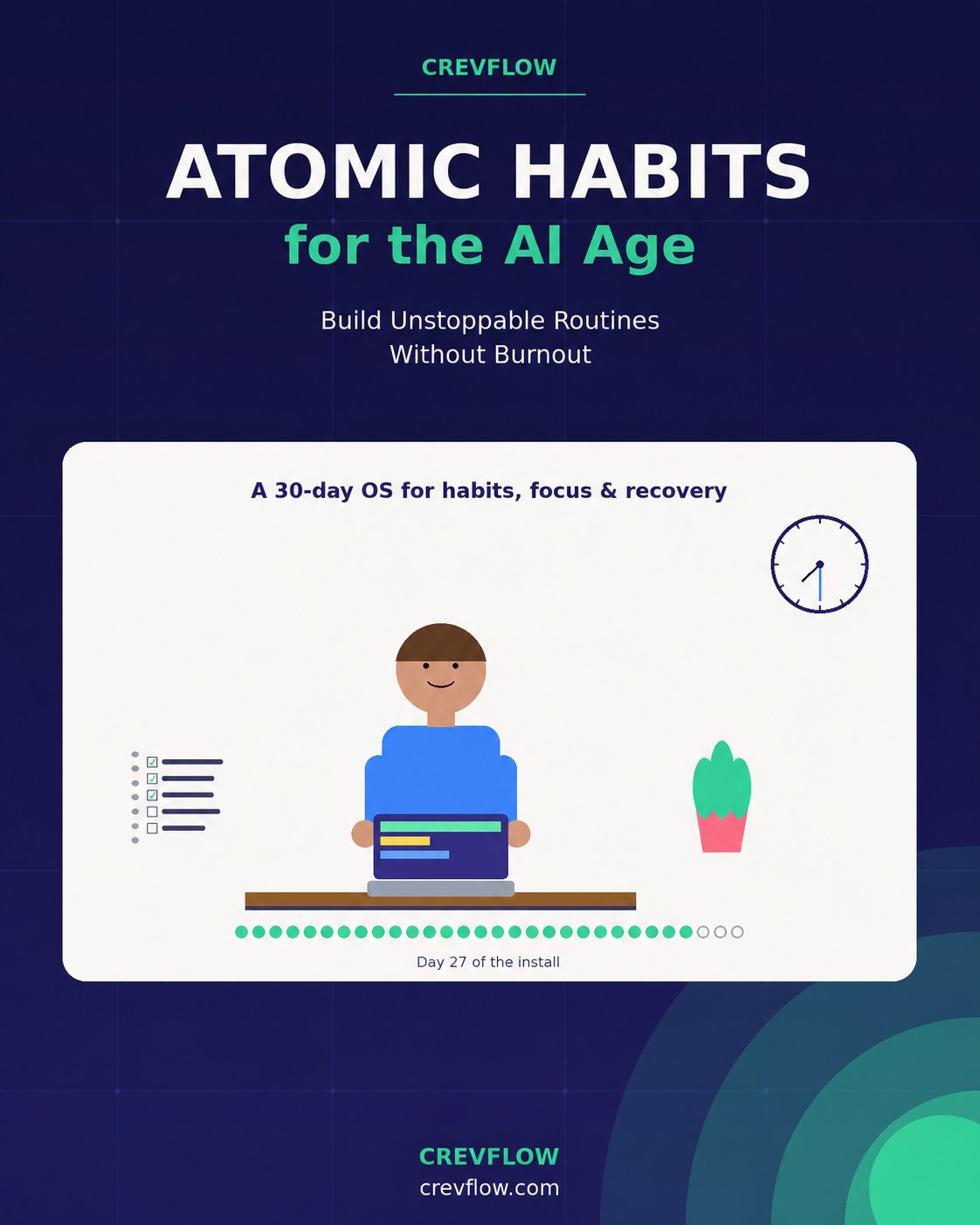
That is exactly why “Atomic Habits for the AI Age” was created — a modern habit-building framework designed for people trying to stay focused, disciplined, and mentally sharp in an AI-driven world.
👉 Read more:
Atomic Habits for the AI Age
The Rise of “Cognitive Outsourcing”
One of the biggest hidden effects of AI is cognitive outsourcing.
This happens when humans slowly transfer thinking responsibilities to external systems.
Examples include:
Letting AI brainstorm instead of thinking independently
Using AI to write before forming original ideas
Asking AI what to do instead of making decisions
Depending on AI summaries instead of deep reading
Relying on AI prompts to start every task
Over time, this creates a dangerous illusion:
Productivity increases while mental ownership decreases.
You may produce more output while becoming less capable without assistance.
That is the paradox of the AI era.
AI Is Not Destroying Discipline — It Is Redefining It
Most people frame the conversation incorrectly.
The danger is not that AI will make humans lazy overnight.
The real danger is subtler:
Reduced frustration tolerance
Lower focus endurance
Increased dependency on stimulation
Weakening self-direction
Declining deep work capacity
Discipline in the AI age is no longer just about working hard.
It is about maintaining:
Independent thinking
Attention control
Cognitive stamina
Decision ownership
Emotional regulation
In previous generations, discipline meant forcing yourself to work.
Today, discipline increasingly means forcing yourself to think.
Infinite Scroll + AI = The Perfect Attention Storm
Modern humans already fight an attention war every day.
Infinite scroll platforms train the brain to:
Seek novelty constantly
Avoid boredom
Switch tasks rapidly
Expect instant dopamine
AI amplifies this environment because it removes waiting entirely.
You no longer need to:
Research slowly
Draft carefully
Organize manually
Learn through repetition
Everything accelerates.
But human psychology was not built for nonstop acceleration.
Without intentional recovery, many people enter a state of:
Constant stimulation
Shallow focus
Mental fatigue
Reduced emotional resilience
Invisible burnout
Ironically, people may appear productive while internally losing clarity.
Identity Drift: The Hidden Cost of AI Dependence
One of the least discussed consequences of AI is identity drift.
Identity drift happens when people stop knowing:
What they genuinely believe
What they truly know
What they can actually do independently
When AI handles too much cognitive labor, people may confuse:
Access to intelligence
withOwnership of intelligence
That distinction matters enormously.
Because confidence built on borrowed capability collapses quickly under pressure.
True confidence comes from internal competence — not external assistance.
The People Who Win in the AI Era
The future does not belong to people who reject AI.
It belongs to people who use AI without surrendering themselves to it.
The highest performers of the next decade will likely:
Use AI for acceleration
Preserve deep thinking ability
Maintain strong focus systems
Protect recovery time
Build disciplined environments
Train independent judgment
In other words:
AI will reward disciplined humans more than undisciplined humans.
Because tools amplify existing behaviors.
AI makes focused people faster.
It also makes distracted people more chaotic.
The New Definition of Discipline
Old discipline:
Wake up early
Work harder
Stay busy longer
New discipline:
Protect attention
Think independently
Resist dopamine overload
Use AI intentionally
Build systems instead of motivation
Recover before burnout
This is why modern habit systems must evolve.
Traditional productivity advice was built for a world with:
Limited information
Slower workflows
Fewer distractions
Less algorithmic manipulation
The AI era changes all of that.
Build Habits That Survive the AI Era
If you feel like AI is making you faster but mentally scattered, you are not alone.
Atomic Habits for the AI Age introduces:
The Habit OS framework
The AI Co-Pilot Stack
Identity-based behavior systems
The 30-Day Habit Challenge
Burnout prevention systems for modern workers
Designed specifically for professionals navigating AI-heavy workflows.
The Real Question Nobody Is Asking
The future is not simply:
“Will AI replace humans?”
The deeper question is:
“What human abilities disappear when convenience becomes infinite?”
That is the defining psychological challenge of this decade.
Because the more powerful AI becomes, the more valuable human discipline becomes.
Final Thought
AI is not inherently dangerous.
Used correctly, it can become:
A teacher
A coach
A strategist
A creative partner
A productivity multiplier
But without awareness, it can also become:
A dependency engine
A focus destroyer
A decision substitute
A cognitive crutch
The goal is not to reject AI.
The goal is to build a system where technology enhances human capability instead of quietly replacing it.
That may become one of the most important forms of discipline in the modern world.
Ready to Rebuild Your Focus?
If you want a practical system for building discipline, focus, recovery, and consistency in the AI age, explore:
Atomic Habits for the AI Age
A modern habit framework built for infinite scroll, AI dependence, and attention overload.
Includes:
108-page illustrated ebook
30-Day Challenge
AI Co-Pilot prompts
Habit OS system
Full workbook + cheat sheets
Frequently Asked Questions
What is the Habit OS?
The Habit OS is a proprietary 4-layer system for installing habits that survive a hard week.
Layer 1: Identity
Layer 2: Environment
Layer 3: Action
Layer 4: Recovery
Lower layers shape everything above them — meaning most habit failures live one layer deeper than you noticed.
How is this different from Atomic Habits?
This is an original, opinionated framework built specifically for the AI age.
It uses its own terminology:
Habit OS
Drift Loop
Anchor Method
1% Compounder
AI Co-Pilot Stack
Burnout Buffer
Identity Ladder
The book is designed around three modern saboteurs the classics did not fully anticipate:
Infinite scroll
AI dependence
Identity drift
How long is the ebook?
114 pages of action-driven content including:
Full-color illustrated visuals
Complete 30-day workbook
Three bonus sections
12-page Habit OS Cheat Sheet
Glossary
Designed to be read in two sittings, then used daily for thirty days.
Is this just another self-help book?
No.
Most self-help books explain. This one prescribes.
Every chapter ends with:
A journal prompt
An identity statement
An “Install Sheet” worksheet
The 30-Day Challenge is the spine of the book, not an afterthought.
What is the AI Co-Pilot Stack?
A 5-tier framework for using AI tools like ChatGPT, Claude, and Gemini as a habit coach instead of a distraction.
Tier 1: AI writes the prompt, you write the answer
Tier 5: AI becomes a continuous thinking partner
The bonus library includes 50 ready-to-paste prompts across all 5 tiers.
What is a “Day X Win”?
After each day’s action, readers record a one-sentence win.
Example:
“Day 5 win: I trusted my system instead of restarting it.”
Many readers share their Day X Wins publicly as a streak-based accountability system.
Who is this for?
Anyone trying to install lasting habits in a fast-paced career.
Especially useful for:
Professionals
Founders
Knowledge workers
Students
Creatives
Particularly those who suspect AI is making them faster — and lazier — at the same time.
Is there a free preview?
Yes.
The free 5-page preview includes:
Cover page
Table of contents
Introduction
Beginning of Chapter 1
Read it before deciding.
What format do I get?
Instant digital download in PDF format.
Readable on:
Phone
Tablet
Laptop
E-reader
Reviews
Loading…